

Jointly plan production orders, machines and capacities
Visual Planning® supports companies with digital production planning and links orders, capacities, machines, staff and resources in a central graphical planning board. Production processes, resource allocations and order progress are displayed transparently, enabling bottlenecks and changes to be identified at an early stage and plans to be adjusted flexibly.
Check production planning software against a production order
A production order requires several work stages, suitable machines, available staff and a delivery date. Try out a demo to see how this information is brought together in Visual Planning®:
- Please provide the following details: Record dates, processing times and required resources, or import them via suitable interfaces.
- Allocate capacities: Link work processes with machines, staff and time slots; take existing bookings and maintenance periods into account.
- Rate the changes: In the event of a rush order or machine breakdown, reschedule and check the impact on resource allocations and deadlines.
Dependencies and warnings must be configured to suit the manufacturing process. Visual Planning® complements an ERP/PPS system with graphical planning or is used for specific planning areas. For further details, please see Detailed planning in production and Machine planning.
A practical example of a shared resource overview across sites is provided by the GROB Case Study. Request a demo for your manufacturing process.
How you can optimise your work plans
In medium-sized manufacturing companies in particular, work plans, order data and capacity information are often stored in different systems, spreadsheets or documents. This makes it more difficult to view current machine allocations, available staff and the necessary resources all in one place.
Visual Planning® brings together production orders, machines, staff, products, tools and other resources in a configurable digital planning board.
Depending on the specific process, planning can be carried out on an hourly, daily, weekly or other suitable time basis. Jobs and resources can be clearly allocated and rescheduled in the event of changes.
This creates a consolidated planning overview that enables available capacity, existing bookings and potential bottlenecks to be identified more quickly.

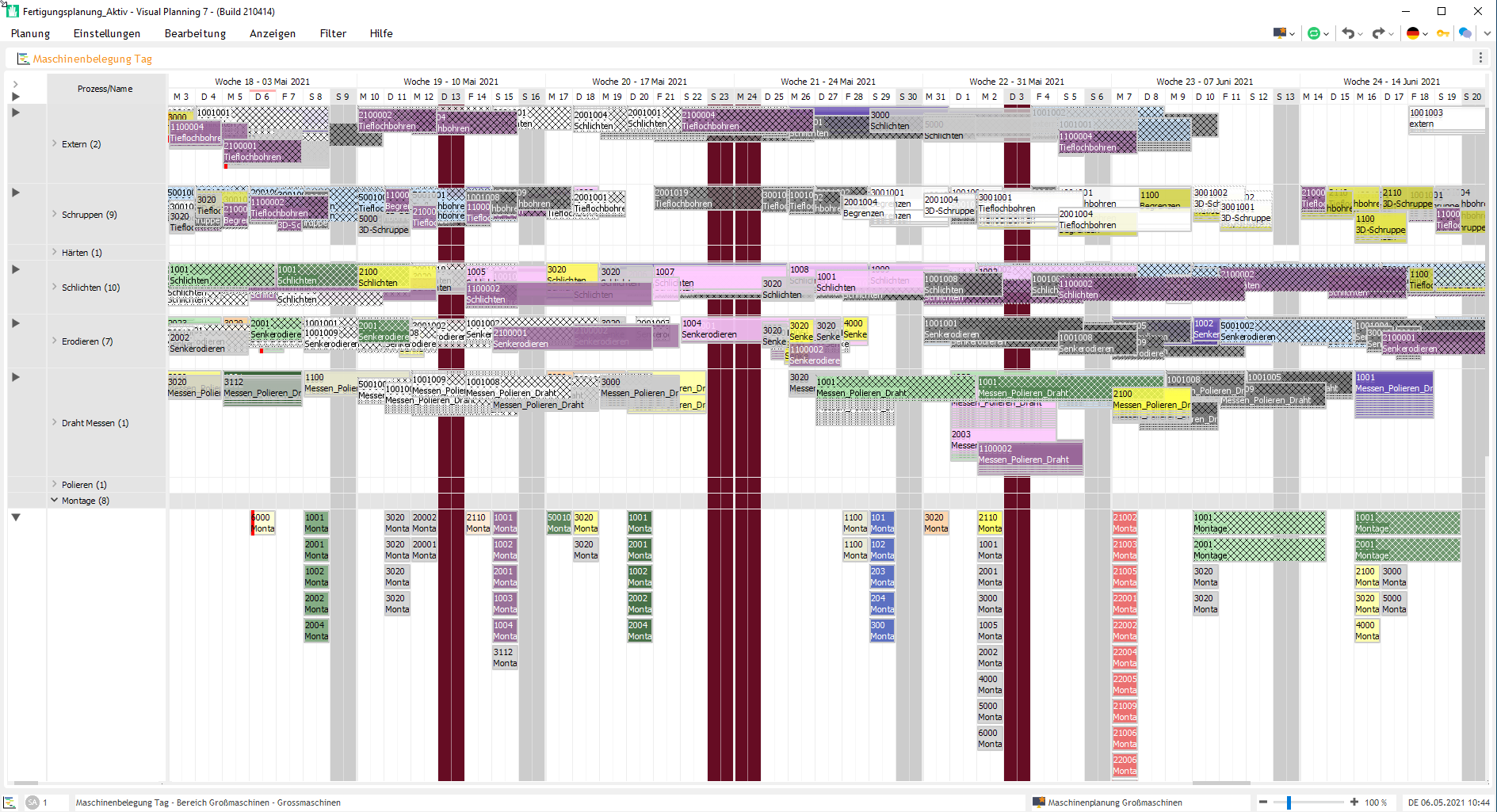
Centrally plan production orders and resources
Visual Planning® helps companies to bring together production orders, machines, workstations, staff and other resources in a graphical planning view.
The display can be adapted to existing workflows. Order status, priorities, deadlines, processing times and further information can be displayed depending on the available data and the configuration.
This provides planning managers with a single overview of current and planned orders. Changes to dates or machine allocations can be made directly on the planning board .
Data from ERP, PPS or other business applications can be imported and updated as part of an interface project. The nature and scope of the integration depend on the systems involved and the available interfaces.
The software does not automatically replace an existing ERP or PPS system, but can supplement it with flexible planning views and graphical scheduling options .
Present capacities and utilisation rates transparently
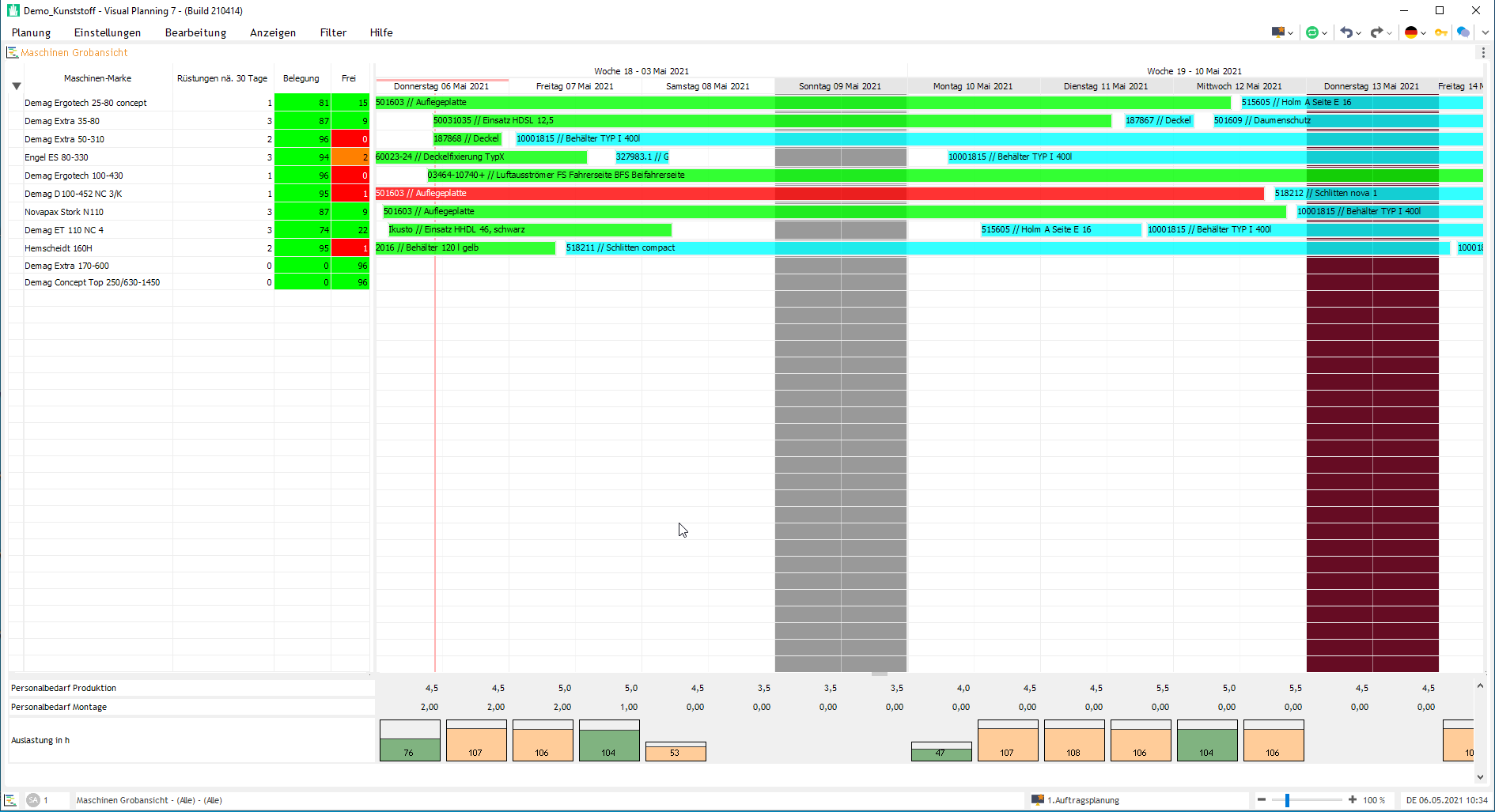
Different views support both short-term order planning and a longer-term analysis of capacity and utilisation.
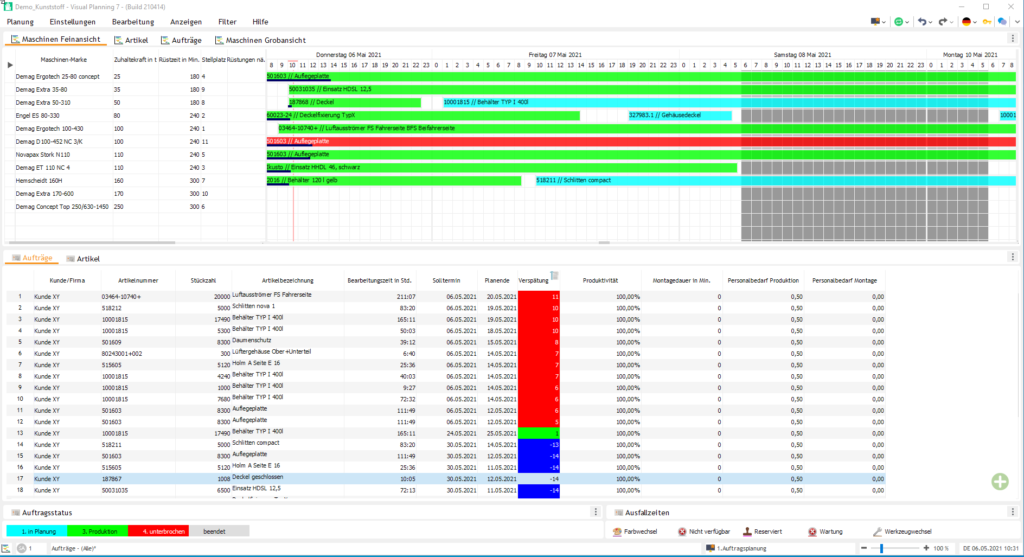
Are you already using an ERP or PPS system and would like to check whether its planning functions are sufficient? Our Decision-making guide: ‘Digital planning board or ERP/PPS’ shows when additional graphical planning is advisable.
Typical applications in production planning
- A graphical extension to an ERP or PPS system: Machine allocations, orders and deadlines are displayed on a visual planning board.
- Planning for individual production areas: Visual Planning® can be used for production areas that are not adequately covered by existing systems.
- Standalone planning solution: Order, customer, item and resource data can be managed directly, depending on the configuration.
- Machine and workstation planning: Orders can be assigned to machines, plant, workstations or production lines.
- Capacity planning: Bookings and available time slots can be compared and analysed in capacity utilisation views.
- Order progress: Status, approved quantities, processing times or other confirmation data can be displayed depending on the process that has been set up.
- Disruptions and maintenance periods: Machine breakdowns, set-up times and scheduled maintenance can be incorporated into the schedule as bookings.
- Changes to dates and priorities: Jobs can be moved and reprioritised using drag-and-drop.
Benefits of visual production planning
Visual Planning® displays orders, resources and dates in configurable planning views. This provides planning managers with a central basis for day-to-day scheduling.
Central order overview
Current and planned production orders are displayed together with their dates and allocations.
Transparent machine utilisation
Occupied and available time slots for machines, plant and workstations are clearly displayed.
Flexible rescheduling
Jobs can be moved using drag-and-drop in the event of schedule changes, rush jobs or cancellations.
Capacity Overview
Utilisation rates and available capacity can be compared side by side in configurable views.
Warnings and planning rules
Overlaps, double bookings or insufficient capacity can be highlighted, depending on the configuration .
Reports and analyses
Order status, capacity utilisation and other planning data can be analysed in customised reports.
Easily edit order planning using drag-and-drop
Production orders can be selected, moved and assigned to a different machine or a different time slot in the graphical planning board.
Dependencies, processing times and other order characteristics can be configured in line with the company’s requirements .
The system supports planning managers in their day-to-day work, but does not replace the professional assessment of priorities, production sequences and operational conditions.
Licensing, the number of users and the required modules are tailored to the actual area of application.
Combining shop floor management and production planning
In shop floor management, production orders, machine allocations, staff, deadlines and current confirmations must all be co-ordinated.
A digital planning board can consolidate this information into visual views. This provides authorised users with a shared overview of planned and ongoing production processes.
Status information, faults, order progress and key figures can be displayed depending on the available data and the specific configuration.
Which key figures and feedback are relevant to the respective company will be determined during the requirements analysis .
Further information can be found at Shop floor management .
Frequently asked questions about digital production planning
What is digital production planning?
Digital production planning refers to the centralised planning and coordination of production orders, machinery, staff, resources, capacities and deadlines using software.
What tasks does production planning involve?
These include, amongst other things, order planning, machine allocation, capacity planning, scheduling, resource coordination and the monitoring of production progress.
Why is digital production planning important?
It provides transparency regarding production orders, allocations and available capacity. Changes and potential bottlenecks are thus identified more quickly.
How does digital production planning work?
Production orders are allocated to machines, workstations, staff or other resources on a digital planning board. Authorised users can edit and update the schedule centrally.
What are the benefits of digital production planning?
It improves the overview of orders, deadlines, machine allocations and capacities. Last-minute changes can be incorporated centrally into the planning process.
Why is Excel often not sufficient for complex production planning?
With numerous orders, machines and last-minute changes, discrepancies in the tables can quickly arise. Dependencies and double bookings must be checked manually.
What are the disadvantages of production planning using Excel?
Changes often have to be updated across multiple files . This can lead to version conflicts, transcription errors and incomplete information.
How can production orders be planned clearly?
Orders can be displayed on a digital planning board, prioritised and allocated to machines, workstations or production lines.
How can capacity bottlenecks be identified at an early stage?
Capacity and utilisation views compare existing bookings with available time slots. This makes potential bottlenecks visible right from the planning stage.
Does digital production planning prevent downtime?
Planned maintenance, machine bookings and known availability can be incorporated into the planning. However, this does not completely prevent unforeseeable technical breakdowns.
How does production planning support production control?
Orders, resources, dates and status information are displayed in shared views. This provides production control with an up-to-date basis for planning.
How do you plan several production lines at the same time?
Multiple machines, production lines or manufacturing areas can be displayed in shared or separate views and planned in parallel.
How does the software help with last-minute changes?
Rush orders, priority changes, rescheduled deadlines or machine breakdowns can be entered centrally and taken into account when re-planning.
How does production planning improve resource utilisation?
Bookings, available capacity and potential overloads are clearly displayed. This provides planning managers with a better basis for allocating orders.
How does production planning support scheduling?
Production and delivery dates can be displayed alongside the required machinery, staff and other resources .
What is meant by detailed planning in production?
Detailed planning assigns individual production orders to specific machines, resources and time slots. It thus forms the detailed operational level of production planning.
What is the difference between production planning and detailed planning?
Production planning considers orders and capacities at a higher level. Detailed planning specifies the exact sequence, resource allocation and time allocation in detail.
How can maintenance periods be taken into account?
Scheduled maintenance can be recorded as bookings or unavailability periods in machine planning, or imported via an interface from another system.
Can digital production planning be used on mobile devices?
Depending on the licence, configuration and system environment, information disclosed via VPPortal in the browser or via VPGo be made available on suitable mobile devices.
What are the benefits of hosted production planning?
A hosted solution provides Visual Planning® in a centrally managed system environment. Access, data backup, responsibilities and possible interfaces depend on the chosen hosting model.
Which businesses is digital production planning suitable for?
It is suitable for manufacturing businesses, mechanical engineering firms, industrial companies, workshops and other organisations with multiple production orders, machines or parallel manufacturing processes.
How does digital production planning improve transparency?
Production orders, machine allocations, capacities and deadlines are displayed in a single planning view. Authorised users can therefore work on the basis of a centralised planning status.
How does digital production planning reduce planning errors?
Centralised data management, traceable changes, planning rules and transparent production overviews can help to reduce double bookings, data transfer errors and communication problems.
Try the production planning software for free
Simply send us your enquiry via the contact form. We will get back to you as soon as possible.
From production planning to actionable detailed planning
Production planning provides an overview of orders, deadlines and available capacity. Once individual work steps have been allocated to specific machines, staff, tools and time slots, the operational Detailed planning in production.
Planned downtime and technical availability should be managed using the Maintenance and repair planning be coordinated. The following demonstrates how a centralised resource overview can support cross-site collaboration: GROB Case Study.